
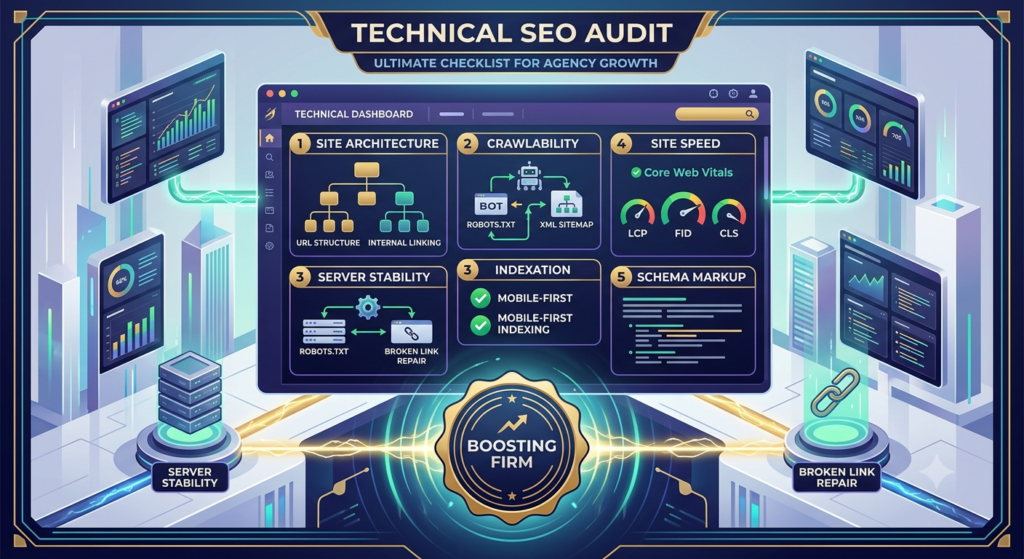
Most agencies spend their energy chasing new content ideas and fresh backlinks, but they often skip the one thing that quietly decides whether any of that work pays off: the technical health of the website itself. A technical SEO audit is the process of checking a site’s backend structure — crawlability, indexing, speed, and code-level issues — to make sure search engines can actually find, understand, and rank the content properly. Agencies like BoostingFirm build their growth strategies around this exact process, because no amount of content or link building fixes a site that search engines can’t crawl properly in the first place.
Here’s a complete breakdown of what a technical SEO audit covers, and how agencies use it to unlock growth for their clients.
What a Technical SEO Audit Actually Covers
A technical SEO audit is not about keywords or content quality — it’s about the plumbing behind the website. It checks whether search engine bots can crawl every important page, whether pages are being indexed correctly, whether the site loads fast enough to keep both users and crawlers happy, and whether there are structural errors quietly blocking rankings.
Skipping this step is one of the most common reasons content and link-building efforts fail to show results. If Google can’t crawl or index a page properly, it doesn’t matter how well-written or well-linked that page is.
Step 1: Check Crawlability and Indexing
Start with Google Search Console’s Coverage report to see which pages are indexed and which are excluded, and why. Look for pages blocked by robots.txt, marked as “noindex” by mistake, or stuck in a crawl error state. A clean XML sitemap submitted through Search Console also helps search engines discover new and updated pages faster.
Step 2: Audit Site Speed and Core Web Vitals
Page speed is now a direct ranking factor, not just a user experience nicety. Run the site through Google’s PageSpeed Insights and check Core Web Vitals scores — Largest Contentful Paint, Cumulative Layout Shift, and Interaction to Next Paint. Common culprits behind poor scores include unoptimized images, render-blocking scripts, and bloated third-party plugins.
Step 3: Fix Broken Links and Redirect Chains
Broken internal links and long redirect chains waste crawl budget and hurt user experience. Tools like Screaming Frog can map out every internal and external link on a site, flagging 404s and redirect loops that need cleaning up. This is a widely recommended step in most professional audit frameworks, and Moz’s technical SEO guide echoes the same point — a clean link structure is one of the simplest ways to help both users and crawlers move through a site efficiently.
Step 4: Review Site Architecture and Internal Linking
A logical site structure — where important pages are no more than three clicks from the homepage — makes it easier for both users and search engines to understand what matters most on a site. Internal linking should reinforce this hierarchy, pointing extra link equity toward priority pages rather than burying them deep in the structure.
Step 5: Check for Duplicate Content and Canonical Issues
Duplicate or near-duplicate pages confuse search engines about which version to rank. Canonical tags should point clearly to the preferred version of any page, especially on sites with filtering, pagination, or multiple URL parameters that can generate near-identical content unintentionally.
Step 6: Confirm Mobile-Friendliness and HTTPS Security
With mobile-first indexing, Google primarily uses the mobile version of a site for ranking. Confirm that pages render properly on mobile devices and that the entire site runs on HTTPS, since browsers now flag non-secure pages, which can quietly push users away before they even scroll.
How Often Should a Technical SEO Audit Be Done
For most active websites, a full technical audit every three to six months is a reasonable baseline. Sites going through major changes — a redesign, a CMS migration, or a big content push — should run one immediately after those changes to catch anything that broke in the process.
Common Mistakes Agencies Make During a Technical SEO Audit
- Treating it as a one-time task instead of an ongoing part of maintenance
- Fixing surface-level issues while ignoring deeper crawl budget or architecture problems
- Overlooking mobile performance because desktop numbers look fine
- Failing to prioritize fixes by actual ranking impact, and instead fixing whatever is easiest first
Final Thoughts
A technical SEO audit isn’t the flashiest part of an SEO strategy, but it’s the foundation everything else stands on. Without it, even the best content and strongest backlinks struggle to reach their full potential in search results. For agencies looking to build sustainable, long-term growth for clients, making this a regular habit — not an afterthought — is what separates steady rankings from constant guesswork.