
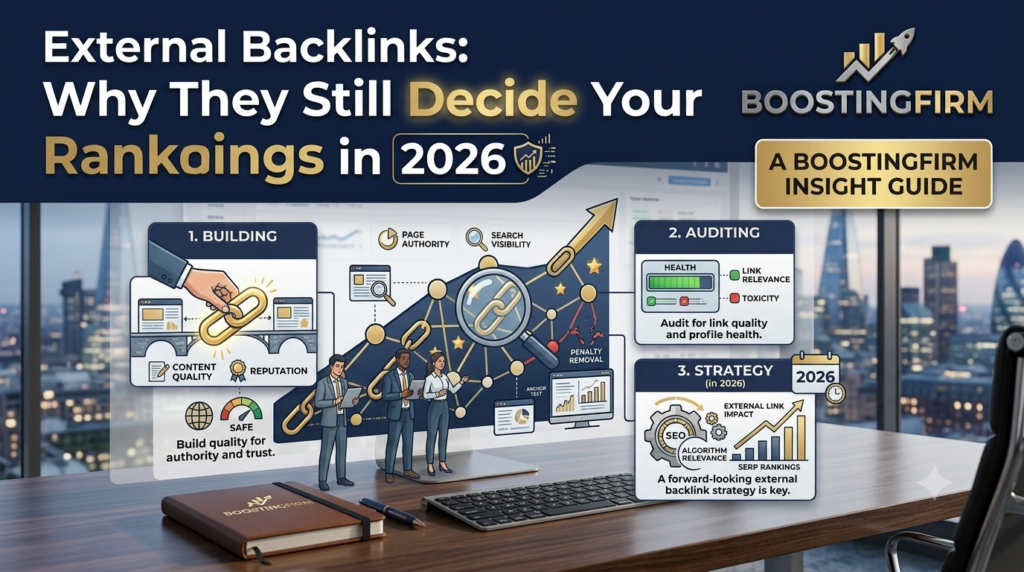
Every website owner wants to rank higher, but very few actually understand what’s pulling the strings behind the scenes. Content matters, structure matters, but nothing moves the needle quite like external backlinks — proven, trusted links coming in from other websites that vouch for your content. Search engines still treat these links as one of the strongest trust signals available, because a link from another site is essentially a vote of confidence that your page is credible, useful, and worth sending people to.
If you’ve ever wondered why two similar pages rank completely differently, the answer is almost always buried in their backlink profiles — and understanding this difference is the fastest way to close the gap.
What Are External Backlinks, Exactly
External backlinks are links from a domain that isn’t yours, pointing to a page on your site. They’re different from internal links, which connect pages within your own website. When another site links to you, search engines interpret it as a clear signal that your content is credible, authoritative, and genuinely worth referencing.
Not all backlinks carry the same weight, though. A link from a well-established, relevant site in your niche is worth far more than a link from a random, low-quality domain with no real traffic or authority behind it. Quality, not quantity, is what actually drives sustainable ranking growth.
Why External Backlinks Still Matter So Much
Search algorithms have evolved significantly over the years, but backlinks have remained one of the most consistent and reliable ranking factors through nearly every major update. According to Ahrefs’ in-depth ranking factors study, pages with a higher number of quality referring domains consistently rank better in search results, reinforcing just how much authority still shapes visibility today.
That doesn’t mean quantity wins on its own. A page with ten backlinks from trusted, authoritative sites will usually outperform one with a hundred backlinks from spammy or unrelated domains — a distinction that separates long-term ranking success from short-lived spikes.
How Search Engines Evaluate a Backlink’s Quality
A few factors decide whether a backlink actually helps:
- Relevance — a link from a site in your niche carries more weight than one from a completely unrelated industry
- Authority — established, trusted domains pass along more credibility than newer or low-traffic sites
- Placement — a link inside the main content of a page usually counts more than one buried in a sidebar or footer
- Anchor text — descriptive, natural anchor text helps search engines understand what the linked page is about
Common Ways to Earn Quality External Backlinks
Building a strong backlink profile takes time, but a few approaches consistently work:
- Guest posting on relevant, respected sites in your industry
- Digital PR — getting mentioned in news articles, roundups, or expert commentary pieces
- Creating linkable assets like original research, data studies, or in-depth guides other sites naturally want to reference
- Reclaiming unlinked mentions where a site talks about your brand but hasn’t linked to you yet
- Broken link building — finding dead links on other sites and offering your content as a working replacement
Mistakes That Hurt Your Backlink Profile
- Buying links in bulk from low-quality, irrelevant sites just to inflate numbers
- Over-optimizing anchor text with the exact same keyword phrase repeatedly
- Ignoring where links are coming from and assuming all backlinks are automatically good
- Focusing only on quantity while ignoring the relevance and trust of the linking site
How to Check Your Current Backlink Profile
Start with Google Search Console’s “Links” report for a free, basic overview of who’s linking to you. For a deeper look — including historical links, lost links, and competitor comparisons — tools like Ahrefs and Semrush give a much fuller picture of where your link profile stands today.
Final Thoughts
External backlinks aren’t a shortcut, and they were never meant to be gamed with volume alone. The sites that consistently earn strong, relevant links tend to be the ones putting out content genuinely worth linking to — not just chasing numbers for the sake of it. Building a healthy backlink profile takes patience, but it remains one of the most reliable ways to build lasting authority in search results.