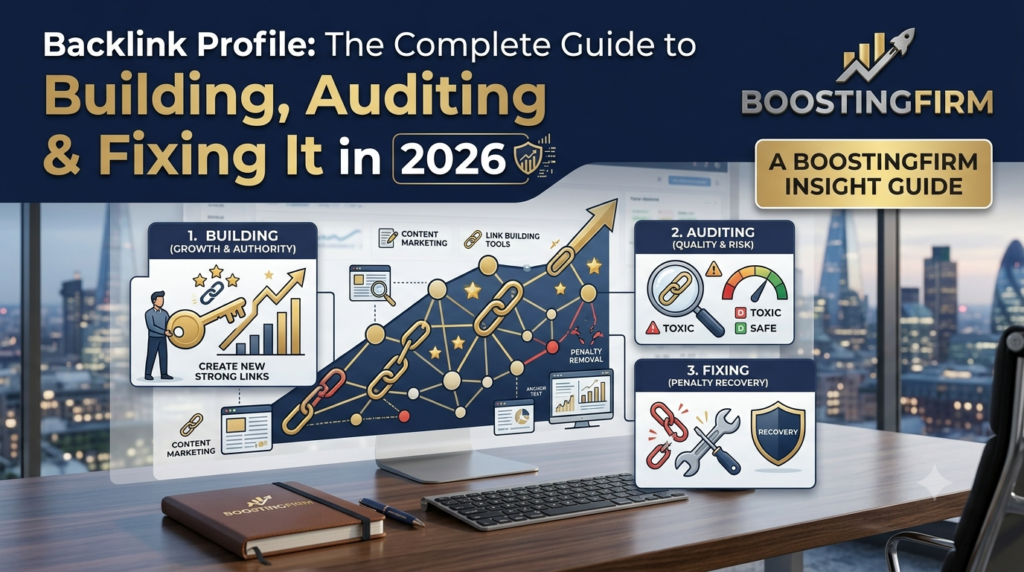
If you’ve spent any time researching SEO, you’ve come across the term backlink profile — but most articles online only scratch the surface. They tell you it’s “the collection of links pointing to your site” and stop there, without explaining what actually makes a backlink profile strong, how to build one the right way, or how to fix one that’s already damaged. At Boosting Firm, we work with backlink profiles every day, and this guide breaks down everything we’ve learned from that hands-on experience.
This guide covers all of that — from the fundamentals to advanced auditing and recovery strategies — so you walk away with a complete, practical understanding of your backlink profile and exactly what to do next.
What Is a Backlink Profile?
A backlink profile is the complete picture of every external link pointing to your website — including where those links come from, how they’re built, what anchor text they use, and how trustworthy the linking websites are. Think of it as your website’s “credit history” in Google’s eyes: it’s not just about how many links you have, but the quality, diversity, and pattern of those links over time.
Google doesn’t look at backlinks one by one — it evaluates the profile as a whole. A site with 200 relevant, natural backlinks from real websites will almost always outrank a site with 2,000 low-quality, spammy links.
The 7 Elements That Make Up a Backlink Profile
Most guides only mention “quality vs. quantity.” A real backlink profile analysis looks at seven specific factors:
1. Referring Domains
Not total backlinks — the number of unique websites linking to you. Ten links from one site carry far less weight than ten links from ten different sites.
2. Domain Authority / Domain Rating Distribution
A healthy profile has a natural mix — some links from very high-authority sites, some from moderate ones, and a few from newer or smaller sites. An unnaturally uniform profile (all DA 90+ or all DA under 10) often signals manipulation.
3. Anchor Text Ratio
Your anchor text mix should look natural: mostly branded terms (your company name) and generic phrases (“click here,” “this article”), with only a small percentage of exact-match keyword anchors. An over-optimized anchor text ratio is one of the fastest ways to trigger a Google penalty.
4. Follow vs. Nofollow Ratio
A natural backlink profile includes both dofollow and nofollow links. A profile that’s 100% dofollow often looks manipulated, since real-world linking (social shares, forums, directories) naturally produces nofollow links too.
5. Link Placement Context
Links embedded naturally within relevant content carry more weight than links stuffed into sidebars, footers, or irrelevant directory listings.
6. Topical Relevance
A backlink from a website in your own industry is far more valuable than a backlink from an unrelated site, even if the unrelated site has higher authority.
7. Link Velocity
The speed at which you gain new backlinks. A sudden spike (say, 500 new links in one week) looks suspicious to Google, while steady, gradual growth looks natural.
Healthy vs. Toxic Backlink Profile: Side-by-Side Comparison
| Factor | Healthy Profile | Toxic Profile |
|---|---|---|
| Referring Domains | Steady, gradual increase | Sudden spikes or long stagnation |
| Anchor Text | Mostly branded/generic, few exact-match | Repetitive exact-match keywords |
| Link Sources | Relevant, niche-related sites | Unrelated, spammy, or foreign directories |
| Dofollow/Nofollow Mix | Natural blend of both | Almost 100% dofollow |
| Link Placement | Inside relevant content | Sidebars, footers, link farms |
| Growth Pattern | Gradual, consistent | Erratic bursts followed by silence |
A Real-World Example
Imagine two websites targeting the same keyword. Site A has 3,000 backlinks, but 90% come from unrelated, low-quality directories with identical exact-match anchor text. Site B has only 300 backlinks, but they come from 250 unique, topically relevant websites with a natural anchor text mix and steady monthly growth.
In almost every case, Site B will outrank Site A — because Google isn’t counting links, it’s evaluating trust. This is exactly why chasing backlink quantity without profile quality rarely works long-term.
How to Check Your Backlink Profile
You can analyze your backlink profile using tools like Google Search Console (free), or third-party platforms like Ahrefs, Semrush, or Moz. Here’s what to actually look at, beyond just the total number:
- Referring domains growth over time — is it steady or erratic?
- Top anchor texts — are they naturally varied?
- Toxic score / spam score — flagged by most SEO tools
- Lost vs. new links — are you losing more than you’re gaining?
- Competitor comparison — how does your referring domain count compare to competitors ranking above you?
Building a Strong Backlink Profile: A Practical Roadmap
Most articles stop at “get quality backlinks.” Here’s an actual roadmap:
Step 1 — Audit your current profile first. You can’t build a strong profile without knowing what you’re starting from. Identify existing toxic links before adding new ones.
Step 2 — Prioritize relevance over raw authority. A DA 40 site in your exact niche is often more valuable than a DA 70 site in an unrelated industry.
Step 3 — Diversify your link types. Combine guest posts, niche edits, contextual backlinks, and natural brand mentions rather than relying on a single tactic.
Step 4 — Control your anchor text mix. Keep branded and generic anchors as the majority; use exact-match keyword anchors sparingly.
Step 5 — Grow gradually. Aim for consistent monthly growth in referring domains rather than large bursts.
Step 6 — Monitor monthly, not yearly. A backlink profile changes constantly — links get removed, sites go down, and new opportunities appear. Monthly monitoring catches problems early.
How to Fix a Toxic or Damaged Backlink Profile
If your rankings have dropped and you suspect your backlink profile is the cause, here’s the recovery process:
- Export your full backlink list using Search Console or an SEO tool.
- Identify toxic links — spam directories, link farms, irrelevant foreign-language sites, or links from previously penalized domains.
- Attempt manual removal first — contact webmasters and request takedown.
- Use Google’s Disavow Tool for links you can’t get removed. Submit a disavow file listing the toxic domains.
- Rebuild with quality links — don’t just remove bad links, actively replace them with relevant, authoritative ones.
- Track recovery over 2–3 months — backlink profile recovery isn’t instant; Google needs time to recrawl and reassess.
Common Backlink Profile Mistakes to Avoid
- Chasing link quantity instead of relevance
- Using the same exact-match anchor text repeatedly
- Buying links in bulk from low-quality marketplaces
- Ignoring nofollow links entirely (they still add natural diversity)
- Never auditing the profile after the initial link-building push
Frequently Asked Questions
What is a good backlink profile? A good backlink profile has links from diverse, topically relevant, authoritative websites, a natural anchor text mix, a healthy dofollow/nofollow ratio, and steady growth over time — not just a high total link count.
How often should I check my backlink profile? Ideally once a month. This helps you catch toxic links early and track whether your link-building efforts are actually improving your referring domain count.
Can a bad backlink profile hurt my rankings? Yes. A backlink profile filled with spammy, irrelevant, or manipulated links can trigger algorithmic devaluation or manual penalties, directly hurting your rankings.
How many backlinks do I need for a strong profile? There’s no fixed number — it depends on your niche and competition. Focus on matching or exceeding the referring domain count of the pages currently outranking you, with equal or better relevance.
Final Thoughts
A strong backlink profile isn’t about chasing the highest possible number of links — it’s about building a natural, diverse, and relevant link footprint that Google trusts over the long term. Regular audits, gradual growth, and a focus on relevance will always outperform shortcuts.
At Boosting Firm, we help businesses build and repair backlink profiles the right way — through manual outreach, niche-relevant guest posts, and ongoing profile monitoring across 10,000+ verified websites.
Want a free backlink profile audit? Get in touch with Boosting Firm today.
Looking to improve your website’s rankings across the board — not just backlinks? Read More: Affordable SEO Services →